
Heat transition - What Does It Mean?
26.06. 2022 | Reading time 5 min

Conrad Gierow, M.Sc.
The energy transition is increasingly associated with the term heat transition. But what does heat transition actually mean and why is it of central importance for the energy transition?
Overview
Introduction
Due to the noticeable effects of climate change, climate and environmental protection have become central issues with high social and political relevance. Reducing greenhouse gas emissions with the long-term goal of climate neutrality is the energy industry’s task of the century.
Climate neutrality can only be achieved with extensive defossilization of the electricity, heat, and transport sectors. This means phasing out coal, oil, and natural gas. In return, a rapid expansion of renewable energies is required, and a transformation of mobility and heat supply through the introduction of new technologies is necessary.
The heat supply is undergoing change and will fundamentally change in the coming years. The heat transition has been initiated.
Why the Heat Transition Is So Important
In Germany, about half of the total final energy is consumed in the form of heat. Only about 16% of this comes from renewable sources. Thus, there is a particularly large potential for saving CO2 emissions in the heating sector.
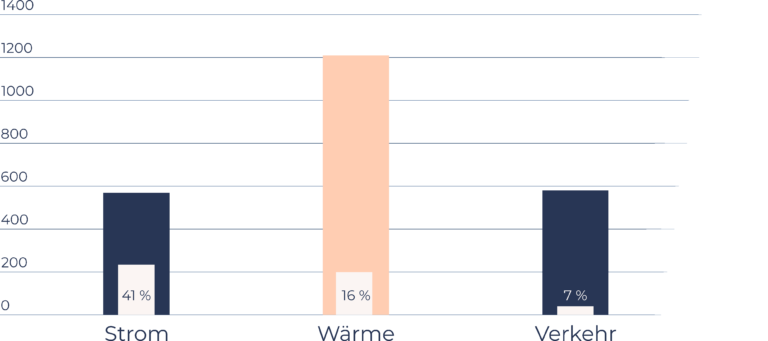
German final energy consumption in 2021, shown in TWh (Data: BMWK, Time series on the development of renewable energies in Germany, February 2022)
To utilize this potential, some federal states already have an obligation for municipalities to establish a so-called municipal heat plan, which develops a strategy for converting the heat supply to exclusive use of renewable sources. This makes the heat transition the central energy policy challenge for municipalities in the coming decades.
The core question of the heat transition is therefore how it is possible to combine climate neutrality and year-round secure supply with the available heat potentials while simultaneously minimizing costs to ensure social compatibility. Answering this question is a very complex task due to the many boundary conditions and influencing factors to be considered.
Heat Transition in Your Own Home
Private households account for about 50% of German heat energy demand. This includes single-family homes, apartment buildings, and dense residential quarters. Especially for single-family homes and apartment buildings, individual solutions for climate-neutral heat provision have already been implemented and tested in many cases.
For buildings of newer construction, these are often small and medium-sized air or ground source heat pumps, whose efficiency has steadily increased in recent years. Is this already a heat transition?
The climate neutrality of such energy conversion systems based on electrical power stands or falls with the origin or CO2 footprint of the electrical energy used. Even a well-designed, current heat pump with an annual coefficient of performance of five emits about 100 g CO2 equivalents for every kilowatt hour of heat output with the current German electricity mix. Thus, even modern buildings quickly accumulate several hundred tons of greenhouse gas emissions per year.
Such technologies are an important step in the right direction and provide the basis for a successful heat transition. Nevertheless, the heat transition is not a task that can be solved individually. It requires the overarching expansion of renewable energies.
Energy Saving
Every kilowatt hour saved does not need to be provided in the form of energy and thus simultaneously relieves both production and transport capacities. Energy savings are therefore always preferable to efficiency measures in energy conversion. In the area of heat supply for existing buildings, extensive renovation measures are usually necessary for this, the effect of which is economically and ecologically sensible in the long term.
Municipal Heat Planning
Especially in urban areas, such as cities and larger municipalities, municipal administration is assigned a major task in realizing the heat transition. As coordination centers for the development paths for reducing energy demand on the one hand and increasing climate-neutral heat provision on the other, they play a key role on the path of the heat transition.
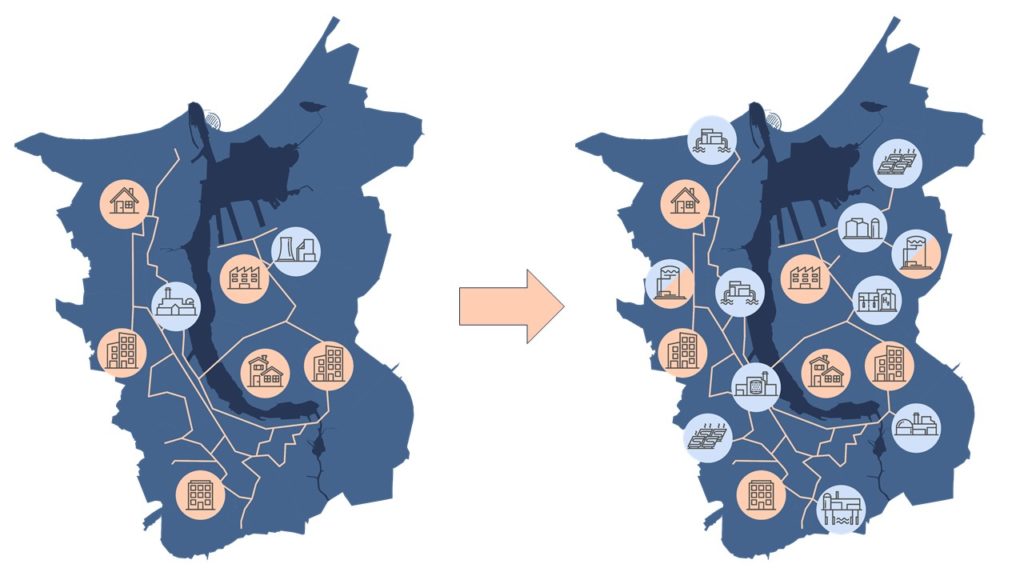
Through targeted heat planning, unused potentials in the urban area can be identified and made usable, for example, through network-based heat concepts. A typical example is waste heat potential from industrial processes.
Waste heat from industrial processes refers to energy that is at too low a temperature level to be efficiently usable for the actual process. However, through a connected heat network, this energy can be collected and used for heat supply. This reduces the need for conventionally supplied energy and thus directly contributes to the reduction of emissions.
In addition to waste heat, renewable heat sources can also be utilized using techniques such as solar or geothermal energy. To decouple the energy flows of fluctuating feed-in systems from the heat demand profile over time and thus ensure security of supply at all times, the development, conceptualization, and integration of high-performance thermal energy storage systems is an essential component of the heat transition.
Conclusion
The heat transition is a complex undertaking that essentially rests on four pillars:
- The reduction of heat demand through energy-efficient construction and renovation measures
- The switch from fossil primary energy sources such as gas or heating oil to renewable energies
- The utilization of otherwise unused waste heat potentials from industrial plants
- A sustainable concept for the distribution and storage of thermal energy
Mastering these requirements sustainably, socially responsibly, and efficiently presents the heat transition as one of the most complex tasks of the coming decades.
We are happy to support you with heat planning and accompany your heat transition from the beginning. Please get in contact with us.
Conrad Gierow, M.Sc.
Share this post
Similar Posts


